
Side hustles are not growing the way they were a few years ago. Fewer Americans have one now than at any point since 2017, and the people who kept theirs are earning more than ever.
This page collects the most recent side hustle statistics from the surveys and government sources that publish their methods, with the date and sample size beside each figure so you can judge it yourself. Every chart is original and free to reuse with a link back to this page.
Key side hustle statistics
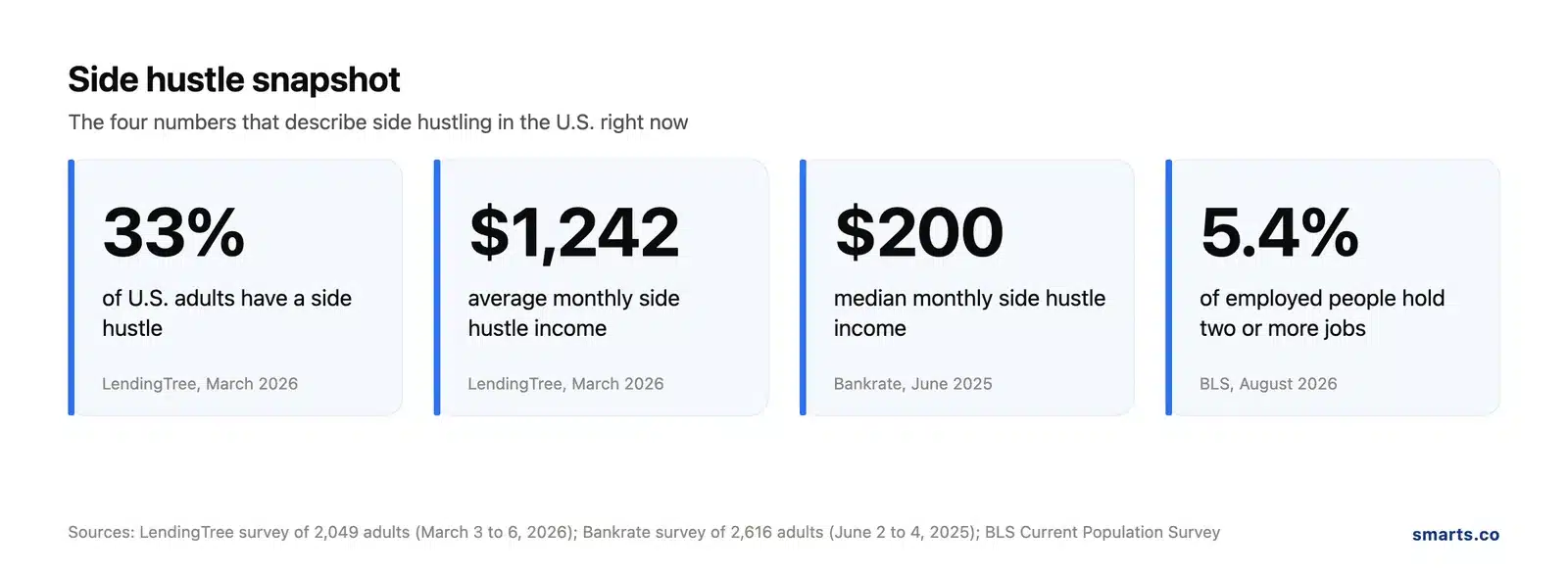
- 33% of U.S. adults have a side hustle, down from 38% in 2025 and 44% in 2022.LendingTree, March 2026, 2,049 adults
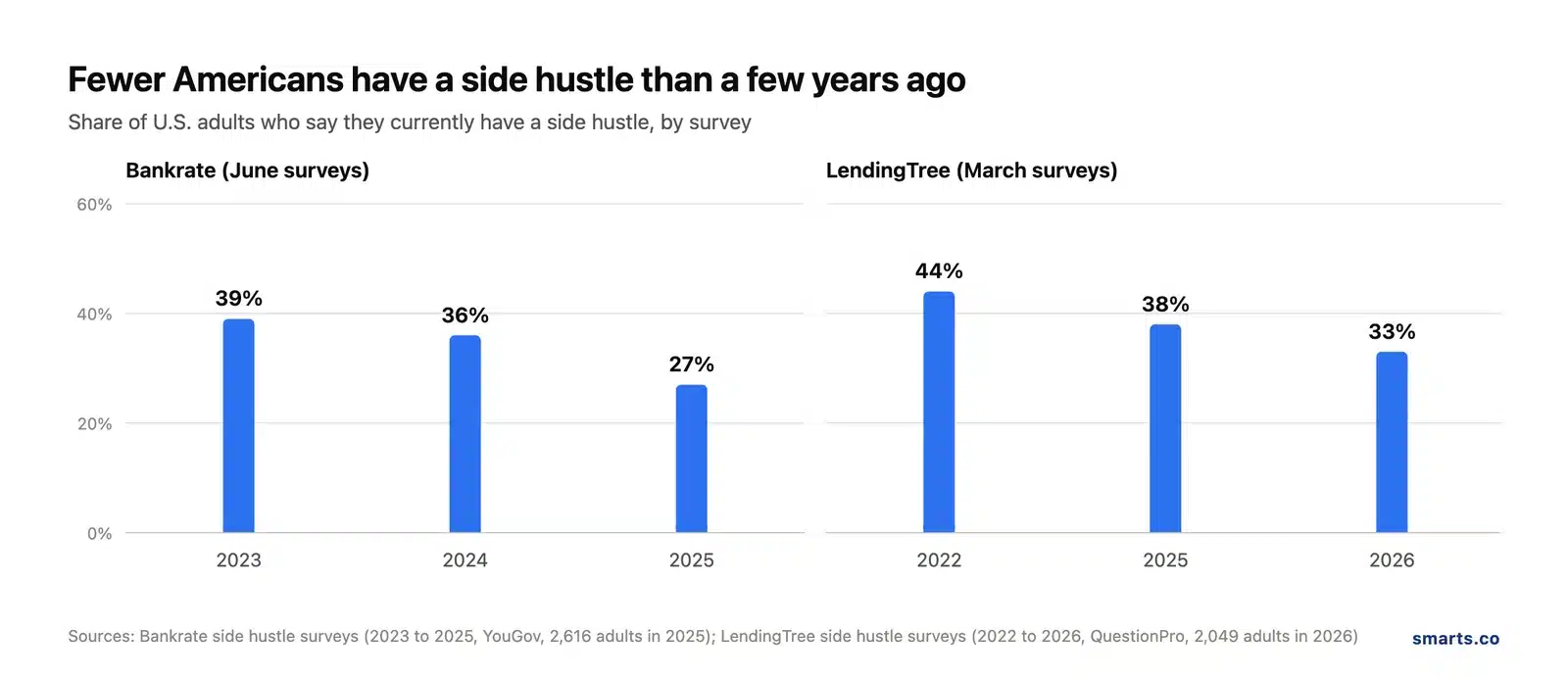
- 27% is Bankrate’s figure, down from 36% in 2024 and 39% in 2023. It is the lowest reading since 2017, when it was 19%.Bankrate, June 2025, 2,616 adults
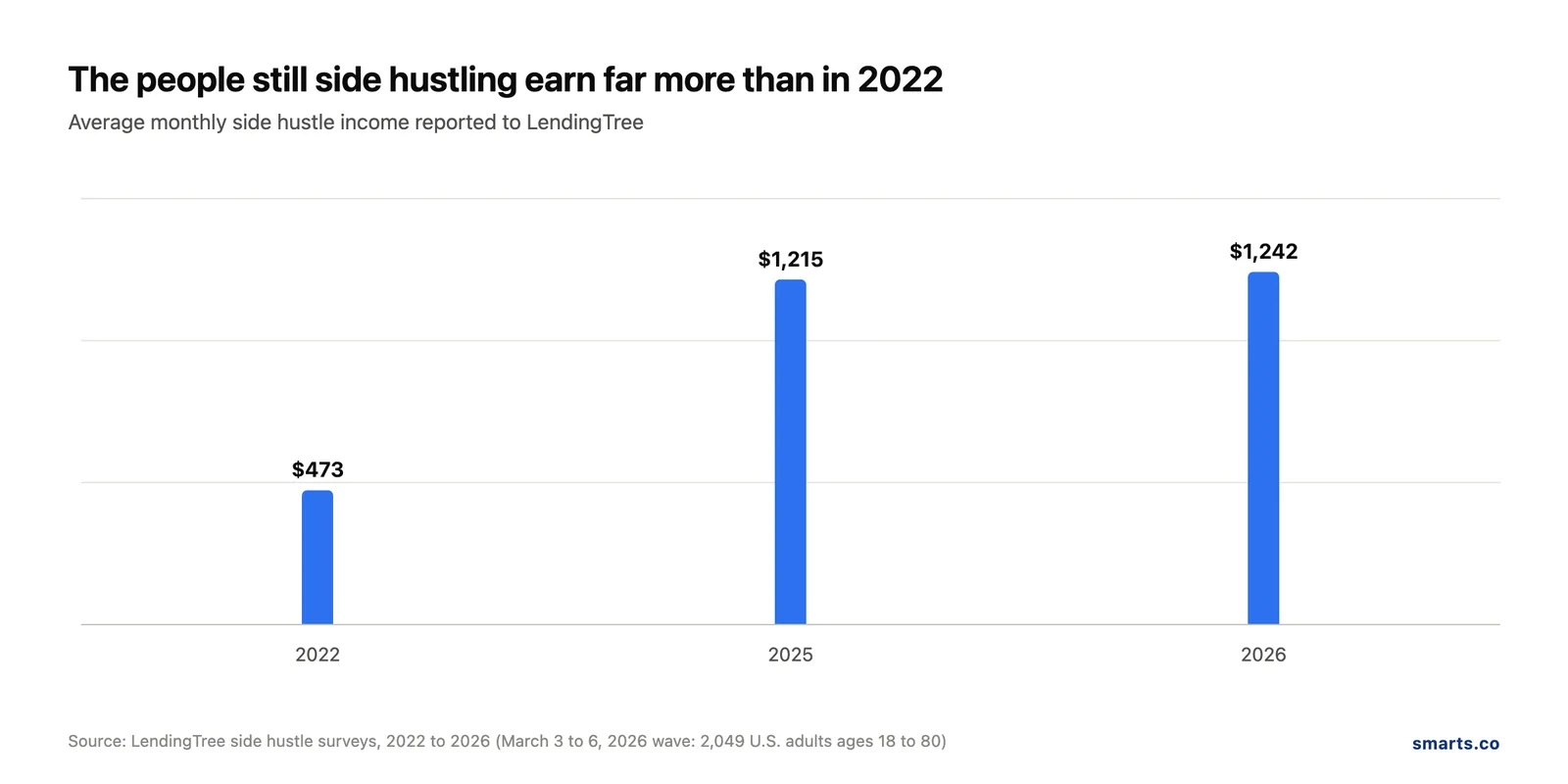
- Side hustlers earn $1,242 a month on average, up from $473 in 2022.LendingTree, March 2026
- The median is far lower at $200 a month. Only 25% clear $500 and only 14% clear $1,000.Bankrate, June 2025
- 35% use the money for regular living expenses, and 29% expect to always need a side hustle to make ends meet.Bankrate, June 2025
- 61% say life would be unaffordable without the extra income, and 69% would rather live on one paycheck if they could.LendingTree, March 2026
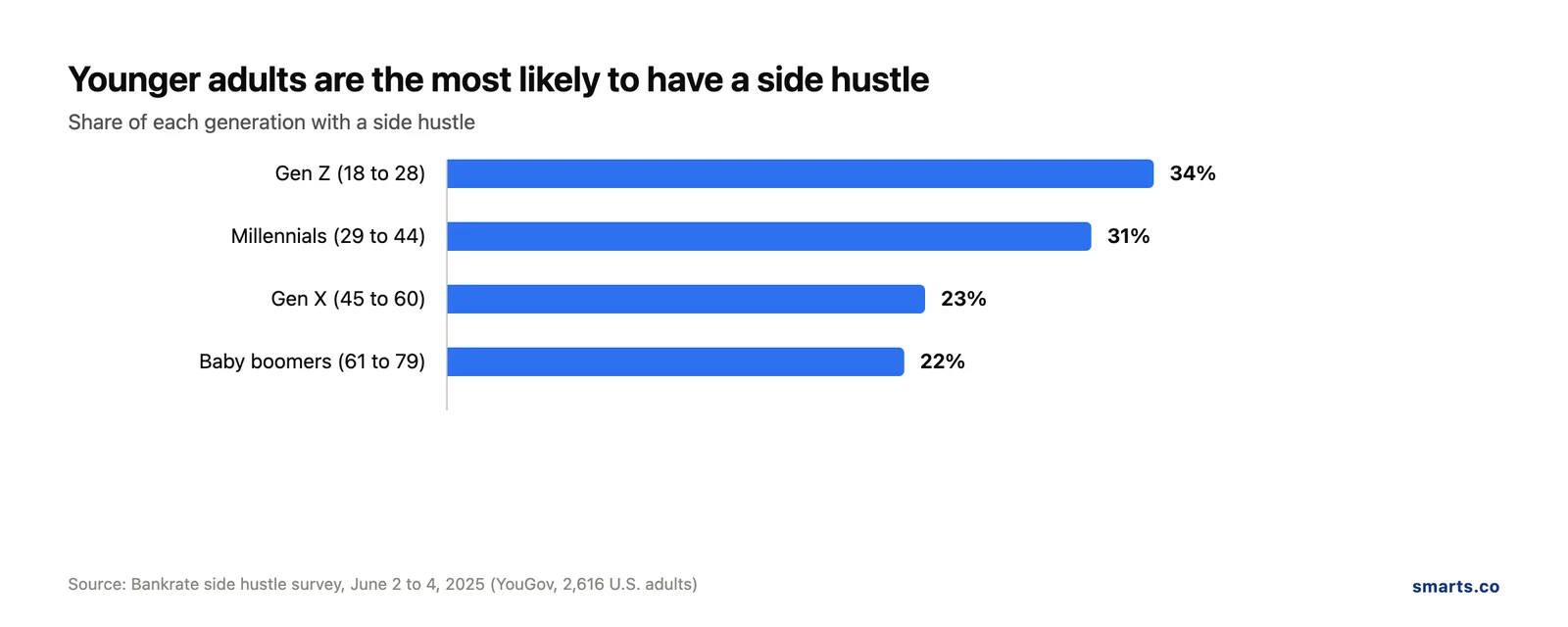
- Gen Z leads at 34%, then millennials 31%, Gen X 23% and baby boomers 22%.Bankrate, June 2025
- Men average $1,195 a month against $611 for women.Bankrate, June 2025
- 20% of adults did some form of gig work in the past month, and 70% of them spent under five hours a week on it.Federal Reserve SHED, fielded October 2024
- 5.4% of employed Americans hold two or more jobs, about 8.8 million people.Bureau of Labor Statistics, August 2026
How Many Americans Have a Side Hustle?
Somewhere between a quarter and a third of adults, depending on who is asking. LendingTree put it at 33% in March 2026. Bankrate put it at 27% in June 2025. The two use different pollsters, different months and slightly different wording, so they should not match exactly.
What matters is that both are falling, and falling fast. LendingTree has gone from 44% in 2022 to 38% to 33%. Bankrate has gone from 39% in 2023 to 36% to 27%, its lowest reading since 2017.
The federal data measures something narrower and tells the same story from the other side. The Bureau of Labor Statistics counts people holding two or more formal jobs, not gig apps or reselling.
In August 2026 that was 5.4% of everyone employed, about 8.8 million people, below the post-pandemic high of 5.7% in November 2025 and above the 5.1% of February 2020.
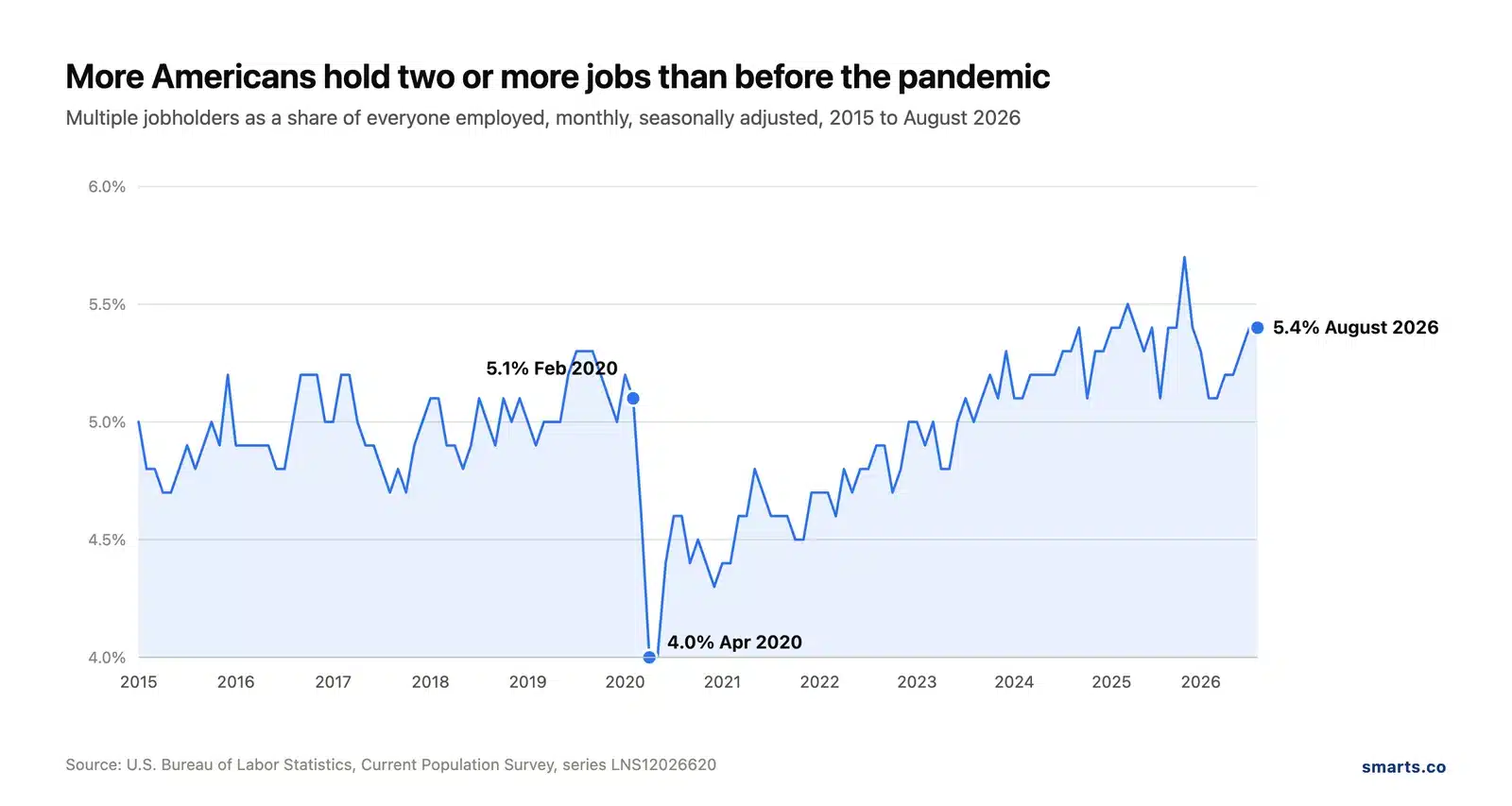
It has now been at or above 5% for 38 straight months, the longest such run since the one that ended in June 2010, though still below the 6.5% record set in November 1996.
Fewer people say they side hustle, but more people are formally working two jobs. Those are not contradictions. The casual, optional side hustle is what has faded.
Why the surveys disagree. Bankrate counts anyone with a side hustle in June. LendingTree asks in March, right after tax season, and includes activities like investing and adult content that other polls skip. The Fed counts only gig activity in the prior month, which is why its 20% is lower than both. When you cite a side hustle statistic, cite the survey and the month with it.
Why Are People Side Hustling?
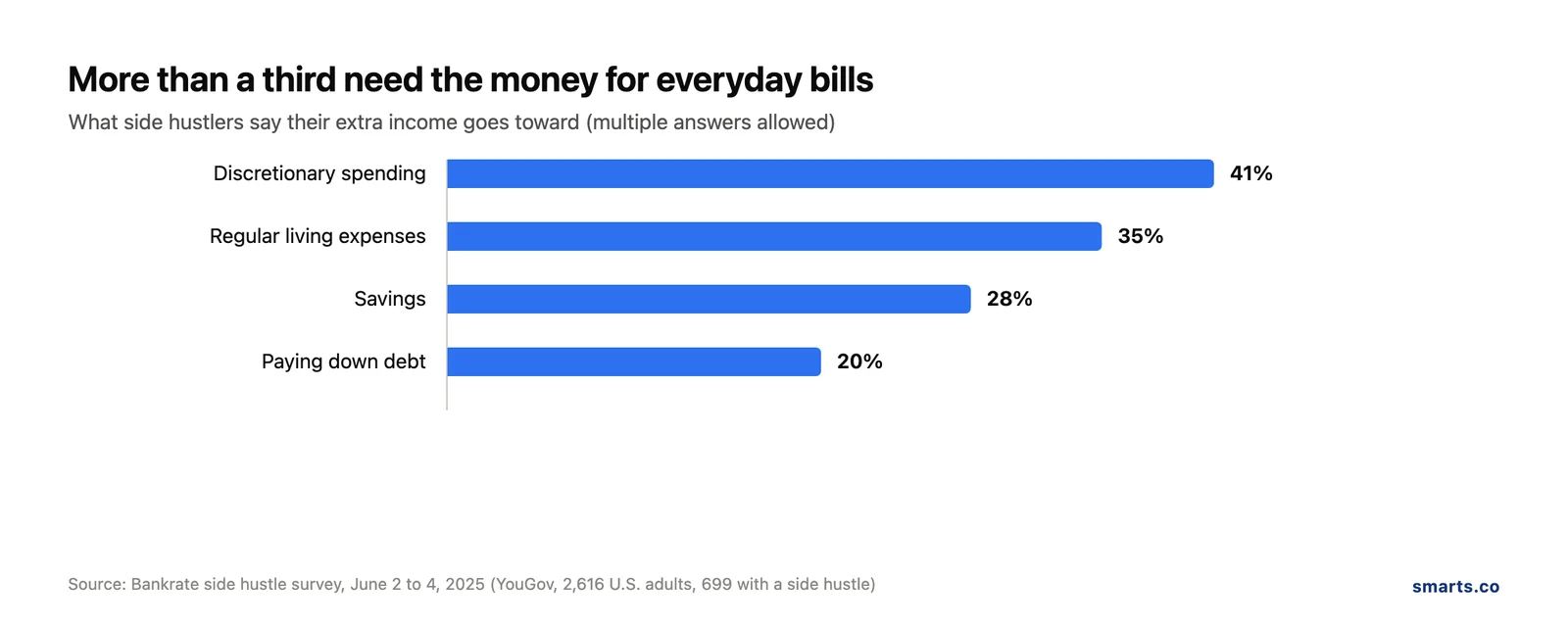
Less for fun than in 2021 and more out of necessity. Bankrate found the biggest share, 41%, use the money for discretionary spending. But 35% need it for regular living expenses, 28% direct it to savings and 20% use it to pay down debt.
LendingTree asked the question a different way and got a starker answer. One in four side hustlers rely on the income to cover essential bills. 36% point to the economy as the reason they started and 31% name inflation specifically.
The dependence is the part that has changed most. 61% told LendingTree their life would be unaffordable without the extra income.
29% told Bankrate they expect to always need a side hustle to make ends meet. Asked what they would cut if it ended, 39% said dining out, 37% shopping, 33% entertainment and 32% streaming.
That also explains why side hustling is falling rather than rising. It is work people take on under pressure and drop when they can. 69% said they would choose a single income if it covered everything.
If you are in that squeeze right now, a cash advance app bridges a gap faster than a side hustle can, though it is a stopgap and not income.
The exception is the youngest group. Among 18 to 35 year olds, 49% told Intuit the main draw is being their own boss and 42% said pursuing a passion, and 66% had either started a side business or planned to.
That survey is from November 2024, so treat it as the mood of the moment rather than a current count.
How Much Do People Make From Side Hustles?
The average has jumped and the median has barely moved. Those two facts describe the same market. LendingTree reports average monthly earnings of $1,242 in 2026, up from $1,215 in 2025 and $473 in 2022. Bankrate reports an average of $885, roughly flat on 2024.
The median tells you what a typical person actually takes home. Bankrate puts it at $200 a month, down from $250 the year before. Only 58% of side hustlers earn more than $100 a month. 25% clear $500 and 14% clear $1,000. More than a quarter, 28%, make between $1 and $50.
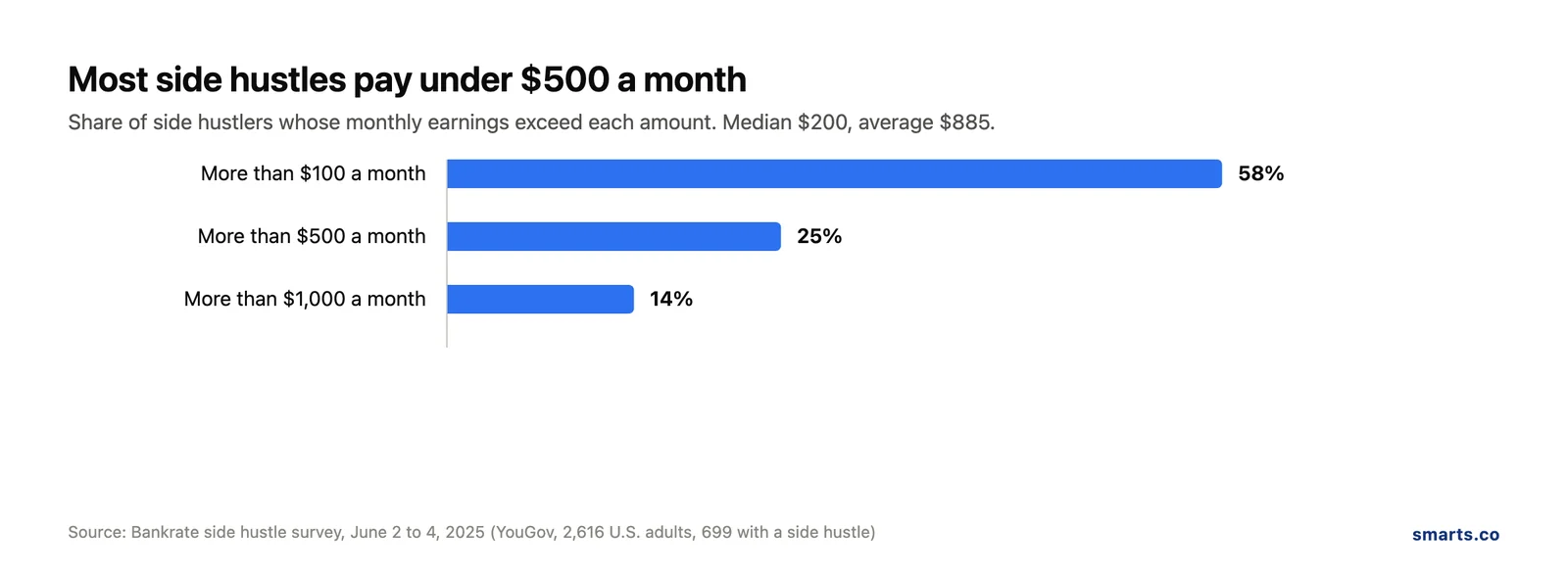
So when a headline says side hustlers earn $1,242 a month, read it as a small number of high earners pulling up an average. Half of side hustlers make $200 or less.
Who earns the most is consistent across surveys. Millennials average $1,029 a month, Gen Z $968, boomers $918 and Gen X $512 in Bankrate’s data.
Men average $1,195 against $611 for women, and the gap holds at the median too, $247 against $148. Men are also far more likely to say the side hustle strengthens their long term security, 58% against 36% of women.
For most people it is a supplement, not a second salary. 28% told LendingTree it makes up 10% to 24% of their income and another 28% said under 10%. Only 16% told Bankrate they want it to become their main income, rising to 21% of Gen Z.
How Much Time Do Side Hustles Take?
Less than the word hustle suggests. The Federal Reserve found 70% of people doing gig work spent under five hours a week on it, and 96% spent under 35 hours. Only 21% considered it their main job.
LendingTree found a slightly heavier commitment among people who call it a side hustle. 32% put in five to ten hours a week and 24% put in 11 to 15. Most are not new to it either. 37% have kept the same side hustle for one to two years.
Time is the constraint that decides whether a side hustle grows. In the Intuit survey of 18 to 35 year olds, 44% named a lack of hours in the day as their biggest obstacle, ahead of money or skills.
What Are the Most Popular Side Hustles?
Driving, delivering and freelancing. LendingTree groups side hustles into categories, and the top three in 2026 were gig and on-demand work at 29%, freelance and professional services at 26%, and creative, content and media work at 23%.
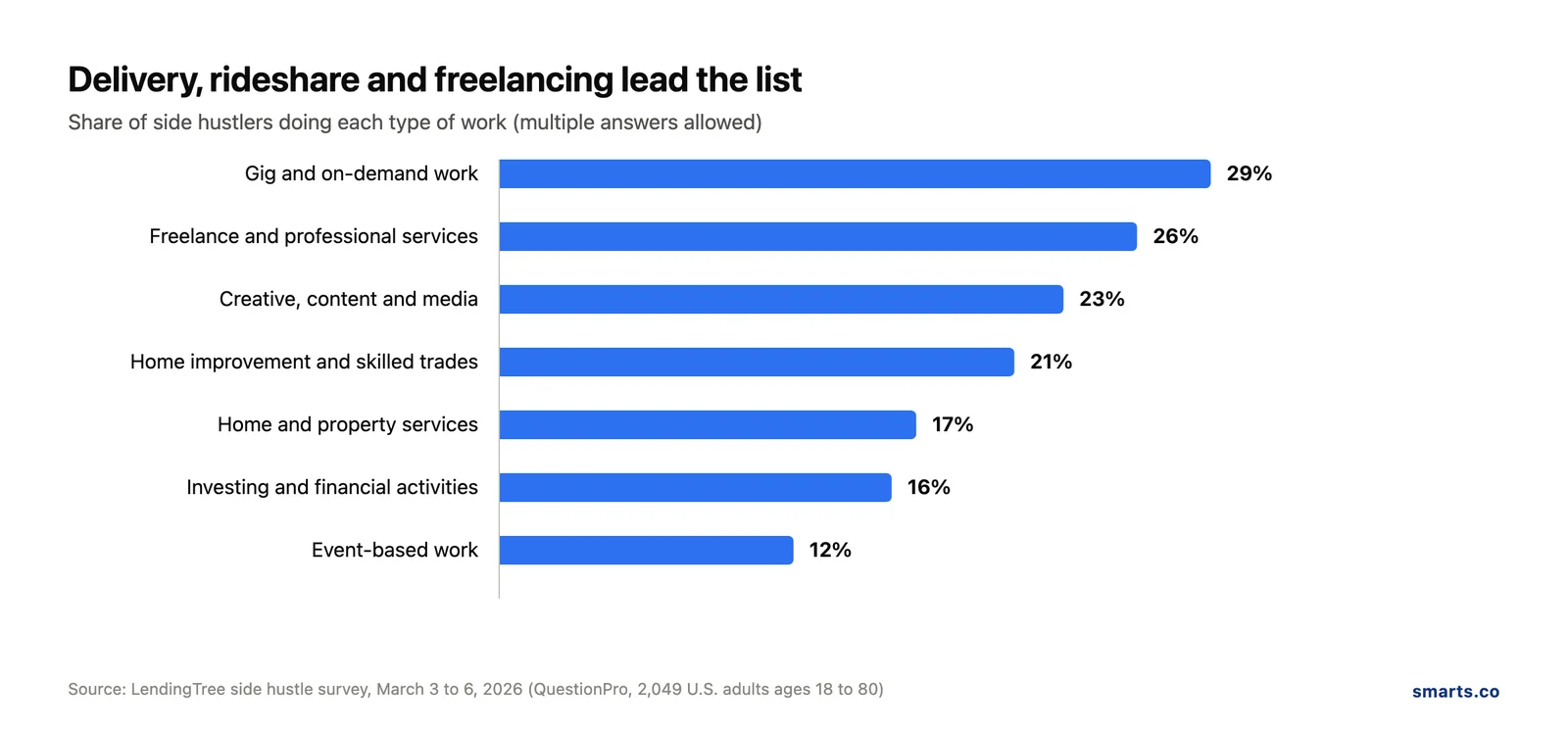
Home improvement and skilled trades came in at 21%, home and property services 17%, investing 16% and event work like DJing and photography 12%. LendingTree also recorded 9% in adult content and 8% in activities it describes as illicit, which other surveys do not ask about.
Bankrate asks about specific activities rather than categories and gets a flatter list. Selling things online leads at 15%, then professional services 14%, food delivery 9%, crafts 9%, pet care 7% and tutoring 6%.
If the gig route appeals, our list of the best gig economy apps compares what each one pays and how fast.
The Fed measures gig activity in the prior month and finds the same shape. 13% of all adults sold something, 9% did short term tasks like driving or delivery, 4% worked through an app platform and 2% rented out property.
Who Has a Side Hustle?
The young, parents, and the more educated. Gen Z leads at 34% in Bankrate’s survey, followed by millennials at 31%, Gen X at 23% and boomers at 22%.
LendingTree sees the same order at higher levels, and a sharp decline among the young. 43% of Gen Z had a side hustle in 2026, down from 62% in 2022.
Millennials went from 55% to 45% over the same period. The Fed’s gig data steps down the same way, 26% of 18 to 29 year olds, 24% of 30 to 44, 21% of 45 to 59 and 12% of those 60 and over.
Parents of children under 18 are more likely to have one, at 34%. So are the highly educated.
32% of people with a postgraduate degree have a side hustle against 23% of those with a high school diploma or less, which cuts against the idea that side hustling is mainly a low income activity. It is often a second income on top of a good one.
Necessity is not spread evenly. Among Black side hustlers, 42% use the income for essentials and 39% say they need it to get by, both well above the overall figures.
What Are the Highest Paying Side Hustles?
No 2026 survey publishes reliable earnings by category, so be wary of any list that ranks side hustles by monthly pay. What the data does show is which traits predict higher earnings.
Hours matter most. The high average and low median in every survey mean the top earners are the minority putting in 15 or more hours a week, and they are concentrated in freelance and professional services, the second largest category in both LendingTree’s and Bankrate’s data.
Skills that command an hourly rate beat platforms that set the rate for you. Delivery and rideshare are the most common side hustles and among the lowest paid per hour once you subtract fuel and mileage. Tutoring, consulting, trades and creative work let you raise your price as you build a record.
For a realistic read on actual pay, our guide to making $1,000 fast covers what each option pays today, and our passive income ideas cover the options that keep paying after the hours stop.
Side Hustle Taxes
The reporting rules changed in 2025 and most side hustle guides still have it wrong. The tax law signed on July 4, 2025 repealed the $600 threshold for Form 1099-K.
For 2026, payment apps and online marketplaces only have to send you a 1099-K if your payments for goods or services exceed $20,000 and you have more than 200 transactions in the year. Both conditions must be met.
The threshold for 1099-NEC and 1099-MISC, the forms clients send to freelancers, rises from $600 to $2,000 for payments made starting in 2026.
None of that changes what you owe. In the IRS’s own words, whether or not you receive a Form 1099-K, you must still report any income on your tax return. The form is a reporting tool. Side hustle income is taxable from the first dollar, and if you net $400 or more you also owe self employment tax. Set aside 25% to 30% of what you earn and track expenses from day one.
Side Hustle Statistics Summary
The side hustle boom of 2020 and 2021 is over. Participation has dropped by roughly a third in both major surveys since 2022. The people who remain are earning more on average, are more dependent on the income, and would mostly rather not need it.
For anyone deciding whether to start one, the honest takeaways are these. Expect around $200 a month at first, not $1,000. Freelance and skilled work pays better than delivery. And the tax reporting threshold is higher in 2026, but the tax itself has not changed.
If you need money sooner than a side hustle can deliver, start with our guide to getting paid today.
Sources
- Bankrate, Fewer Americans Have a Side Hustle in 2025, press release. Survey by YouGov Plc, June 2 to 4, 2025, 2,616 U.S. adults including 699 with a side hustle.
- Bankrate, Side Hustle Survey, full results and generational breakdown.
- LendingTree, Side Hustles Are Declining. Survey by QuestionPro, March 3 to 6, 2026, 2,049 U.S. consumers ages 18 to 80.
- Board of Governors of the Federal Reserve System, Economic Well-Being of U.S. Households in 2024, Employment and Gig Work. Survey fielded October 18 to 31, 2024, published May 2025. The 2025 edition, published May 2026, does not include gig work figures.
- U.S. Bureau of Labor Statistics, Current Population Survey, Multiple Jobholders as a Percent of Employed, series LNS12026620, seasonally adjusted, through August 2026.
- Internal Revenue Service, Understanding Your Form 1099-K.
- Intuit, The Side Hustle Generation. Survey by Pollfish, November 2024, 1,000 U.S. adults ages 18 to 35.

